 |
| 'Tuscarora' with spuria iris 'Betty Cooper', rose 'Marie Pavie' and Origanum dictamnus |
Sunday, May 14, 2017
goodbye sumac

Wednesday, May 10, 2017
evelyn
I was ready to remove all of my 'Evelyn' roses when the first blooms opened like this May 5.


 Of course the misshapen blooms, but I also despise yellow. I planned on removing my three bushes.
But then this happened:


But then this happened:


Then I knew I would have to keep her.
If only I could get her to grow a bit more.

alnwick castle rose
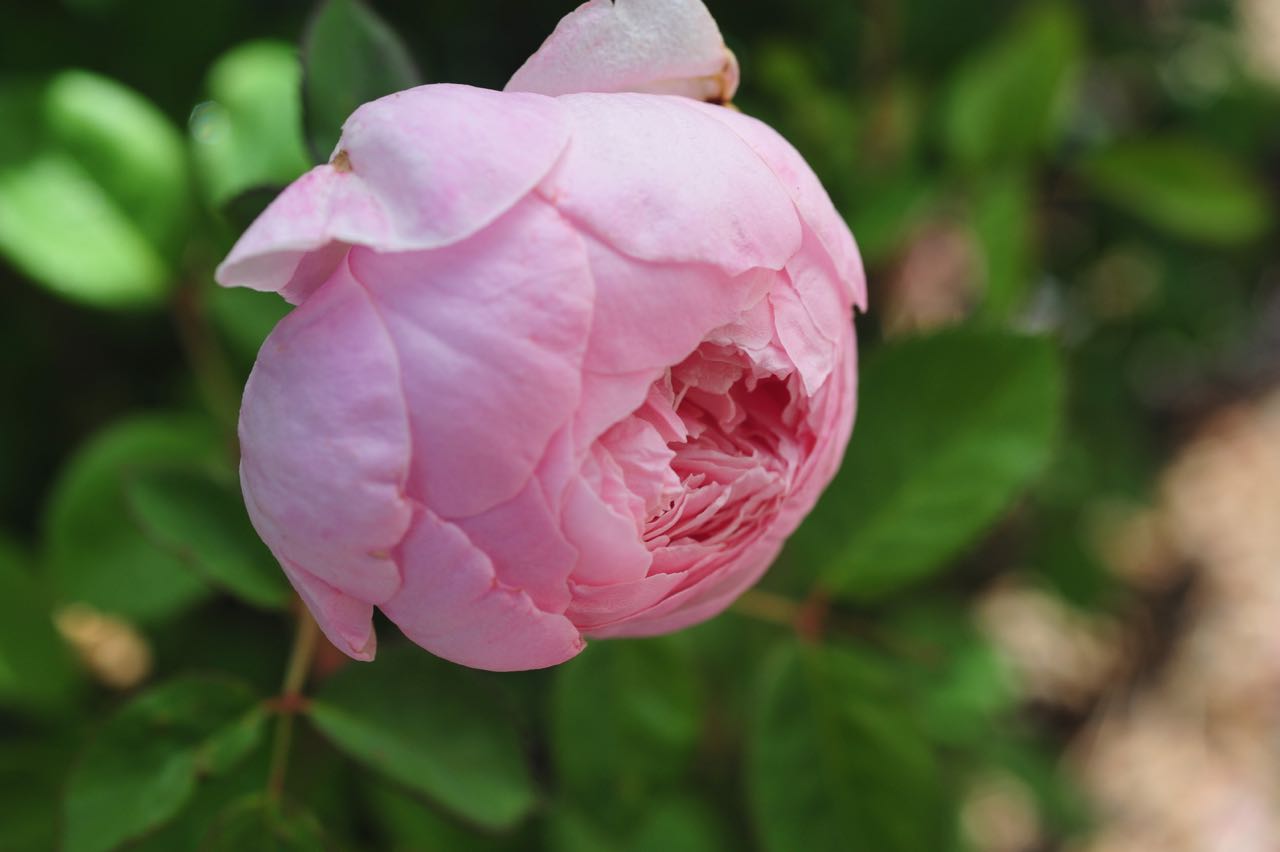
I've been really impressed with my 'Alnwick Castle' rose. First of all, it survived both cold snaps. Second it has a delicious raspberry fragrance. Third, it has beautiful globular to cupped flowers. Fourth, it has a lot of flowers on a well-shaped bush. Fifth, there has been no hint of disease.
 During cooler weather, the flowers are fully opened in this globular form. I think it looks like a quail.


 In warmer weather, they open up a bit, showing the dense smaller petals within. In even warmer weather, the flowers will open up completely. Alnwick Castle doesn't bloom well in the height of summer heat, but then what does?
 No matter what the form, that delicious fragrance is still there. It's like opening a jar of Talento raspberry sorbetto.
 I love how the flowers nod just a bit. Not so much that they look weak, but enough to have some grace.



Sunday, May 7, 2017
cercocarpus
When I was having dessert outside with a few friends yesterday, I looked over at the curl-leaf mountain mahoganies (Cercocarpus ledifolius) that I had planted as a screen. They were just putting on their spring flush of growth, the fresh new shoots a light green against the blue sky. I was struck by their beauty. They gave me a similar impression as the rosemary with all its new growth that I so love. For a moment, I lost track of the conversation. My friends probably thought I had been drinking too much (I hadn't even had a sip!) as a I gazed toward the garden.
 You might think it's silly to be waxing rhapsodic over what might seem to be a pedestrian plant. But in this harsh climate, and especially this year of roller-coaster weather, plants that grow like they are happy to be here are rather unusual.


Sure, it looks like a boring old evergreen shrub in the photos.

It is also reliable, durable, resilient, and adds New Mexico character to a garden. There is a some fragrance, although not that impressive.
 This hybrid, C. ledifolius x intricatus from Plants of the Southwest, is more dense and slower growing than C. ledifolius and faster and looser than C. intricatus. Just as you would expect. I did notice that the seedlings at the nursery were quite variable, however, some more like C. ledifolius and some more like C. intricatus.

The tails on the seeds are just forming. In a month or two, those silky tails will catch the sunlight and the whole shrub will glisten, especially in the morning and late afternoon.

The leaves are also rather fuzzy, giving it a slightly silvery appearance in the sunlight.
 No, they don't have the flash of flowers, but for giving a garden New Mexico character, I certainly appreciate them more than, say, Eleagnus pungens, Photinia, or boxwood.


Although they might not have the flash of extravagant flowers like the irises and peonies that bloom at this time of year, there is an understated rugged elegance to them.

Sure, it looks like a boring old evergreen shrub in the photos.

It is also reliable, durable, resilient, and adds New Mexico character to a garden. There is a some fragrance, although not that impressive.


The tails on the seeds are just forming. In a month or two, those silky tails will catch the sunlight and the whole shrub will glisten, especially in the morning and late afternoon.

The leaves are also rather fuzzy, giving it a slightly silvery appearance in the sunlight.

Tuesday, May 2, 2017
curious
I'm wondering who designed this landscape of the front yard of a new house in my neighborhood.
 At first I was struck by horrible appearance of the soil, which looked like concrete overflow rather than the native soil around here. Then I noticed the aspen which is always planted in my neighborhood, despite seeing most of them dying. Then I was struck by how close they are planted to the house. Then the combination of the thirsty aspen with the dryland red yucca. But look closer.
 What the heck is that? It's planted in full sun in unamended caliche...in the one-plant-in-an-ocean-of-emptiness style that is typical for Albuquerque. Could it be...yes, it is...a fern! or rather, three ferns (see the top photo). Quite the combination with the red yucca, wouldn't you say? Well, since it is something that is not in my landscape vocabulary, I'm really curious as to what kind of fern it is and how long it will last. Maybe I will be impressed, but that's very, very unlikely IMHO.


Monday, May 1, 2017
what a difference a day makes
Before:
Morning 4/28/2017

After
early morning 4/29/2017:

late morning 4/29/2017

evening 4/30/2017

Wednesday, April 26, 2017
i guess this is not the best climate for roses
This year, many of my roses look miserable. We had a warm spell in February and the roses started to leaf out. Then we had a cold spell and the roses didn't look so bad, but then after a month of warmer weather (70-80's for the highs, 40's for the lows) I realized that many of the bushes had dropped all of their buds (the ones that had them) and just were not interested in growing. I tried to understand why: moist soil? Check. Nutrition? Check. Sunlight? Check, check.
My cutting of Madame Alfred Carriere was the worst. After growing well as a cutting alongside my orchids, I put it out to go dormant for the winter. In February, it started to leaf out, then the tiny leaves, perhaps 3 mm long dried up. This went for a few cycles of tiny leaves which dried up. I tried more sun, less sun, more water. Some fertilizer, checking for bugs. Then some branches started dying back. It was freaking me out.
This is what it looked like:


In desperation, I brought it into the house, into the orchidarium. Within 24 hours, there seemed to be some growth. In disbelief, I waited.
Here it is, 3 days later:

 ...and compare the second photo with this, at the fork. Remember this is only 3 DAYS later.
 ...and compare the third photo for the same place on the stem. Mystery solved.
Conclusion: it is climate. Madame just didn't like the weather. After all, same pot, same mix, different climate. So not a good climate for many roses, particularly Madame Alfred Carriere. I find this to be very sad, since Madame has such good fragrance. I know now, that if a rose doesn't do well, it may just be that this climate is not good for it. Maybe it's time to take out the roses. I know I should plant natives. I know!
My cutting of Madame Alfred Carriere was the worst. After growing well as a cutting alongside my orchids, I put it out to go dormant for the winter. In February, it started to leaf out, then the tiny leaves, perhaps 3 mm long dried up. This went for a few cycles of tiny leaves which dried up. I tried more sun, less sun, more water. Some fertilizer, checking for bugs. Then some branches started dying back. It was freaking me out.
This is what it looked like:


In desperation, I brought it into the house, into the orchidarium. Within 24 hours, there seemed to be some growth. In disbelief, I waited.
Here it is, 3 days later:

Compare to the top photo which is the same tip, and you can see the dried up tiny leaves now with some growth.


Conclusion: it is climate. Madame just didn't like the weather. After all, same pot, same mix, different climate. So not a good climate for many roses, particularly Madame Alfred Carriere. I find this to be very sad, since Madame has such good fragrance. I know now, that if a rose doesn't do well, it may just be that this climate is not good for it. Maybe it's time to take out the roses. I know I should plant natives. I know!
Subscribe to:
Posts (Atom)